Begin Again

“In the beginner’s mind there are many possibilities, but in the expert’s there are few”
― Shunryu Suzuki, Zen Mind, Beginner’s Mind: Informal Talks on Zen Meditation and Practice

It’s usually the focus in their eyes I notice first. They may be 22, they may be 52, but they are starting something new. Their heightened situational awareness causes them to engage with the world around them in ways that are often only tapped into by a beginner. I’m here to argue that beginners shouldn’t have all the fun.

It’s the start of another new school year here in Round Rock and I have the privilege of greeting a few hundred new employees around this time each year. It’s always a celebration, but this year I’m bringing increased authenticity to my enthusiasm.

I’ve always been happy to greet these new folks, but there was always a sense of sympathy for the work ahead of them starting something new. They are either entering a new profession and don’t yet know what they don’t know. Or, they are experienced but joining a new organization. They will need to learn the culture, make new work friends, establish their reputation, create new routines, and find a parking spot. They must feel so unsettled.

They are walking into a new building and the only thing they know for sure is that they will meet new people. They get to be whoever they want. We don’t know them yet so even if they were the fool in their last job, they get a new start with us.

Maybe it’s turning 40 soon, or maybe it’s reaching a certain level of comfort, but I’m finding my feelings for these beginners turn from sympathy to envy. And while we can’t turn back the clock, and may not want to find a new job, how can we tap into the mindset that comes from starting something new? From beginning again?

When Suzuki was speaking of Beginner’s Mind he reminded us:

For a while you will keep your beginner’s mind, but if you continue to practice one, two, three years or more, although you may improve some, you are liable to lose the limitless meaning of original mind.

The hard part he goes on to say is not balancing our expert and beginner’s mind, it’s not a dualistic approach. The two ways of thinking do not balance each other. There is a finite amount of space for our mindset and the expert’s mind is in direct competition with the beginner’s mind. Satisfaction comes from learning, improving our craft, growing our skillset, without losing the beginner’s mind. Much easier said than done.

We must remain the learner…even when we are mentoring others. Because we are not really mentoring them. We are learning with them and just playing a different role. None of us really know what we are doing. We are just doing our best.

He goes on to tell us:

The same thing will happen in your other Zen practices. For a while you will keep your beginner’s mind, but if you continue to practice one, two, three years or more, although you may improve some, you are liable to lose the limitless meaning of original mind.

Modern Mentoring = Modern Learning

I’m always grateful my chosen profession requires me to be a reader. Working in public education we are always met with new research, blogs, books, Tweets, “innovative ideas”, and Ed Tech sales people. It’s a never-ending series of inputs that dominate our email inboxes and have required me to create a separate number to better weed through the cold calls from those who find my title on our organization’s web site and want “just a few moments” of my time to share something that is sure to change the face of public education. I love it all, but it get’s to be a lot.

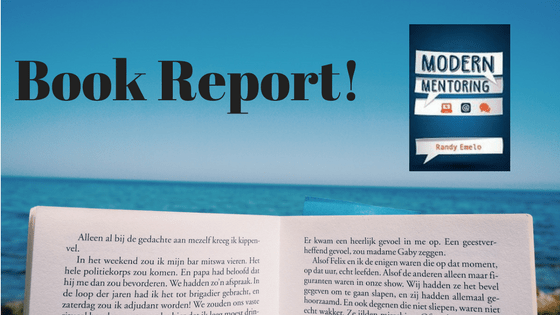
The onslaught of information is all worth it though when you stumble upon something that feels like it was created just for you. I stumbled upon Modern Mentoring recently at the Round Rock Public library. A focus on organizational learning drives my work. While my job title has changed a few times over the last few years, that central focus must be the core value of any leader.

Randy Emelo connects modern mentoring with organizational learning as a whole. The word “mentoring” is so loaded and we make such a big deal out of it that it becomes intimidating. It reminds me of Drew Dudley’s TED talk about lollipop moments and how we have made leadership such a big and daunting proposition that many shy away from it. The same happens with mentoring. As Emelo points out, when we make mentoring into some “expert creates protege” relationship there is too much pressure on each participant. Look what happened with Obi-Won and Annakin.

Modern mentoring is about social learning and an egalitarian approach to communication. This thought resonated so much with my own that I unleashed my own mild Tweet storm on a Saturday morning.

As a firm believer of the 70/20/10 philosophy of professional learning, the importance of flattening communication barriers, a limiting reliance on workshop-based learning, and increasing agency for the individual in driving her or his own learning has never been more important. Some point to the learner who has changed – blame it on the millennials – but I disagree. It’s our work that drives this need for change. Our work requires flexibility where it used to require repetition. Our learning requires choice where it used to require compliance.

Emelo reminds of all of this through the lens of mentoring. All learning that lasts, learning that changes our behavior for the better, is mentoring. Pick up a copy of his book and think about your own learning – especially professionally. Where does it really happen? Do you learn from traditional hierarchical compliance-based systems – or in spite of them? Or do you learn through peer-to-peer networks, informal relationships, and by reflecting on your practice with trusted colleagues?

Are you from Round Rock ISD? Stay tuned for Moden Mentoring to be included in our upcoming organization-wide book clubs.

A Lovely Reunion Born From Tragedy

I looked over at the passenger seat and my heart sank. Empty. They should be there. I drove all the way downtown to make the most of a couple free hours and now it was all for naught. How could I be so careless? Maybe I should just turn around and drive back to my big box in suburbia.

Or maybe, just maybe, I could go for a run without my headphones. Perhaps I could run without a Podcast, audiobook, or playlist filling my airwaves? Somewhere in the ether of memory, I recall a time when I used to run without someone else’s voice accompanying me on on the journey. But that was a different time. A different world. There were no Podcasts and my Walkman was pretty bulky.

Nevertheless, I gave it a shot. And to really walk on the wild side, I even left my phone in the truck. The first mile or so was filled with disappointment. A new Revisionist History podcast has launched the day before and now I needed to find another time to listen. Tragedy.

A key benefit of running the Ann and Roy Butler Hike and Bike trail in downtown, Austin is the multiple opportunities to cut your seven-mile loop short. Cut back across the river at the Pfluger bridge, 1st Street, or Congress Avenue and you can high-tail it back to the comfort of your truck, plug back in, and continue your quest to wow your friends and colleagues at meetings by quoting the latest episode of Radiolab or High Resolution. Such podcast hubris.

Luckily, something kept me from cutting the run short. Maybe it was the novelty of being unplugged and unreachable. Perhaps my ears were able to breathe better. Whatever the reason, the voice I heard about an hour into the run thanked me. The voice was familiar the same way you recognize voices imprinted on the soul during your youth. You can’t place it, but the voice makes sense.

It took me back to runs from my twenties. I was back in Big Bear Lake running the Pacific Crest Trail. I could feel the salty air enjoyed during a quick morning run along the boardwalk in Huntington Beach. Even more than returning to a previous time and place, it was the sound of that voice that made me feel at home. Made me feel more like myself again. I don’t remember much of what it said, and even though I didn’t learn something new from Two Guys on Your Head, I finished that run feeling at peace.

So I’ve stopped outsourcing my headspace to Krista Tippett, Debbie Millman, and Ben Greenfield. They’ve been wonderful companions, but that time on the roads is too important to share. It’s too important because we so rarely combine physical activity with disassociative boredom. That time of productive boredom is why running is a time for creation, not consumption. It’s a time to go wherever that voice takes you.

So it was a lovely reunion and hopefully the beginning of a new affair. I’ll save my podcasts for the gym.

My Pillars of Stoicism and Design Thinking

Peas and carrots, biscuits and gravy, Tango and Cash, impressive duos all. Complimentary ideas and systems help us navigate the world. They help us find balance and understanding. And a current obsession of mine is the duo of Stoicism and Design Thinking.

I can’t remember if it was a podcast, blog post, book, video, or conversation that led me to learn more about Stoicism a couple years ago. But, it was during a season of change and the tenants of Stoicism have rippled through on almost a daily basis. The basic ideas according to The Daily Stoic are:

The (Stoic) philosophy asserts that virtue (such as wisdom) is happiness and judgment be based on behavior, rather than words. That we don’t control and cannot rely on external events, only ourselves and our responses.

Stoicism has just a few central teachings. It sets out to remind us of how unpredictable the world can be. How brief our moment of life is. How to be steadfast, and strong, and in control of yourself. And finally, that the source of our dissatisfaction lies in our impulsive dependency on our reflexive senses rather than logic.

When we work through a time of change our perception guides our reaction. A situation is neither positive nor negative. It just is. Our internal and external reaction is all we can control. Isn’t it freeing to understand that fact? Isn’t it liberating to believe that we are in control, and not passive victims to the reactions of those around us?

We were fortunate to recently learn from Ryan Holiday, author books such as The Obstacle is the Way, Ego is the Enemy, and The Daily Stoic, at the Round Rock ISD World Class Summit – our annual leadership gathering of campus and district leaders. I do my best – to vastly varying degrees of success – to follow the teachings of the Stoics as a personal operating system leading my teams and projects supporting our students, campuses, and departments.

Holiday shared many quotes and stories from the ancients as well as present day leaders who trusted the process, valued living in the moment, and embraced intentionality around their emotions. He spoke of the four disciplines associated with Stoicism – The Discipline of Perception, The Discipline of Action, and The Discipline of Will.

If Stoicism is an operating system for interacting with the world, then design thinking is a system for creating purposeful experiences.

I do remember how I was introduced to Design Thinking around that same time of personal and professional change. If Stoicism is an operating system for interacting with the world, then design thinking is a system for creating purposeful experiences. The Teacher’s Guild, a part of IDEO, revealed the world of Design Thinking to me and many others a few years ago and the idea has resonated in nearly every project since. Pair their website with the Design Thinking for Educators Toolkit and you will be well on your way incorporating this process for designing solutions and learning experience for students and staff.

Doreen Lorenzo kicked off day two of the Summit and shared the way the University of Texas at Austin is incorporating the tenants of Design Thinking into the work of undergraduates. A key idea we are incorporating into our work supporting students, campuses, and departments throughout our organization is directly influenced by design thinking. We create systems, resources, assessments, and experiences through the lens of those we serve. If there is a disconnect in the understanding or implementation of curriculum or an instructional initiative, then that is on us (designers), not teachers (users.)

Public education is mirroring many industries during this time in history which operate in shorter iteration cycles. If Google has a product change it believes may occur more than two quarters away, then it’s considered a long-term horizon possibility. Is six-months long term? We may not be working within such rapid cycles in K-12 education, but it’s difficult to have even a three-year plan.

A blend of Stoicism as a personal operating system and design thinking as a professional operating system will allow us to thrive where others are stifled by either fear of ambiguity or fear of sharing control. Constant iteration, flatter organization structures, open communication, and growing teacher agency all provide us opportunities to design systems to better serve our communities. It’s an incredible time to be a leader in public education. In recent memory, there have never been more obstacles in our path. With each of those obstacles, there are opportunities to use them to our advantage – to flip the perception of critics and create raving fans of bystanders.

Let’s finish with a poem from my favorite children’s book from one of my favorite coaches John Wooden which embraces our bias toward action and honoring of effort along with results.

Action

I scurry ‘round and ‘round each day. Taking Action is my way. I get up and go and give it my all. When Action’s needed, I never stall. And when I look for lunch to eat, I’m not afraid to risk defeat. Don’t fear failure. Try your best. Take some Action for Success.


Make Service Your Lens

I was lucky to have the opportunity this week to speak at the Walsh Middle School National Junior Honor Society induction ceremony and wanted to share my thoughts on service. Thanks for reading.

Before I even begin I want to invite our inductees this afternoon to take a moment and thank those who support their growth and development. It’s not easy being a parent/guardian/teacher/principal and none of us would be sitting here without the dedication of others. So let’s take a moment and give them a round of applause.
I want to thank Dr. Agnew and Ms. Zunker for asking me to share a few thoughts this afternoon. I have so many wonderful memories working with many of your older brothers and sisters when I was lucky enough to serve as the assistant principal here from the day the campus opened and for the next five years. If anyone wants the inside scoop of how they acted when they were in middle school, I’ll stick around after the ceremony.

And one free tip before I jump into the meat of my thoughts today. Always thank your family when you’re giving a speech. So, Kelley, Lincoln, and Harrison, thanks for being here to help me celebrate these students today.

But the major reason I’m excited to talk with you all at this event is to celebrate a community that honors the five pillars of NJHS – Scholarship, Service, Leadership, Character, and Citizenship. We’re going to be hearing about each of those in more depth shortly so I’m only going speak about one – SERVICE.

We are the lucky ones. I do believe that hard work breeds luck, but I also believe that the more we do for others without the expectation of anything in return the happier lives we will lead.

So, my challenge to you, new inductees, is to embrace the idea of SERVICE as much more important than hours, projects, a box to check, or something to enhance your college application. Look at SERVICE as a way of life. Look at SERVICE as a lens to see the world.

In every situation you find yourself, whether it’s navigating a crowded Walsh hallway, working in a small group on a project, welcoming a new student, witnessing a conflict between two peers, or being a son/daughter/sister/brother/friend, ask yourself “How can I be of SERVICE?” “How can I make this situation better for those around me?”

And then take ACTION! Go FIRST! Err on the side of ACTION rather than HESITATION! Don’t be a BYSTANDER!

Be GENUINE, take your SERVICE seriously, and amazing things will happen for each and every one of you.

Thank you.